
Sustainability Consultancy Services
Business sustainability management
AD Frameworks’ consultants will collaborate with your company or department to:
- Determine your present perceptions of business sustainability and how you currently wish it to be defined.
- Encourage the company to reconsider their beliefs and enhance their comprehension within their business sector or industry’s framework.
- Promote and nurture the growth of business sustainability management within your company through workshops designed to integrate sustainability principles into the company’s mindset, procedures and functions.
- Assist in pinpointing central objectives around which the company should focus their aspirations to achieve.

Environmental Policy & Action Plan package
- Teams workshop to frame where the client organisation currently are and what they want to achieve with Environmental Policy & Action Plan.
- Customised Environmental Policy and initial Action Plan
Organisational Carbon Footprints
There are two widely accepted levels of organisational carbon footprint reporting scope that AD Frameworks offer. Both levels of report meet different business needs, either basic reporting requirements or the more advanced and detailed level that is included in Scope 3 wider supply chain requirements.
Organisational Carbon Footprint Scope 1 & 2
- Initial data collation Teams call with Client
- Set up Client on Carbon+Alt+Delete Platform
- Data Collation Requests Issued
- Allowed for a follow up call on data collation progress
- Data review & Carbon Footprint Report Generation

Organisational Carbon Footprint Scope 1, 2 & 3
- Teams Workshop leading on to initial data collation scope with Client Management Team
- Set up on C+A+D Platform
- Data Collation Requests Issued
- Follow up Teams calls on data collation progress refinement of materials, database use, etc...
- Data review & Carbon Footprint Report Generation
- Close down call.
Product/service carbon footprint
Once you understand your organisation’s carbon footprint this can be translated into a product or service carbon footprint, which enables you to clearly communicate your impact to your customers, as part of their ‘Further Indirect Emissions’.
With undertaking a product or service carbon footprint, consideration needs to be given to which scope or extent of reporting for the life cycle analysis is undertaken; whether it is:
Cradle to gate
Cradle to grave
Cradle to cradle
To increase the level of data certainty and a reduction of the number of assumptions, AD Frameworks will help you increase your organisation’s knowledge of how your products or services are utilised by your customers.
Product life cycle
The broader the extent of product or service carbon footprint analysis undertaken, the greater the quantity of assumptions being made – usually around ‘use’ and ‘disposal’. This potentially lowers the level of data certainty – which can influence the accuracy of a life cycle analysis.
After AD Frameworks has calculated your organisational carbon footprint, we can undertake an evaluation of your impact, identify where you can have the greatest effect in reducing your carbon emissions and develop a custom carbon reduction plan.
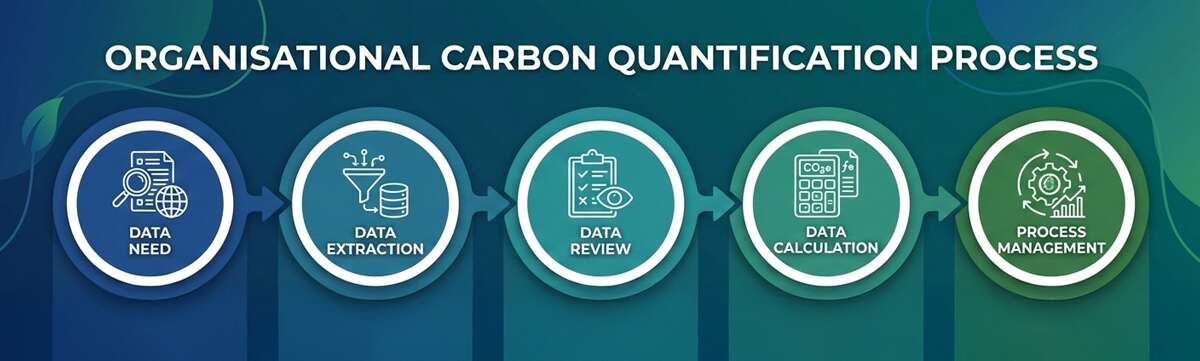
AD Frameworks will tailor the level of support your business needs through the five elements of organisational carbon quantification:
The five principles which AD Frameworks applies to a carbon quantification inventory and report are:

Transparency
Addressing all relevant issues in a factual and coherent manner, based on a clear audit trail. Disclosing any relevant assumptions and making appropriate references to accounting and calculation methodologies and data sources used.

Relevance
Ensuring the inventory appropriately reflects the greenhouse gas emissions for the organisation, and services the decision-making needs of the users.

Accuracy
Ensuring that the quantification of greenhouse gas emissions is systematically undertaken, making sure that uncertainties are reduced as far as practicable. Achieving sufficient accuracy to enable users to make decisions with reasonable assurance as to the integrity of the reported information.

Completeness
Accounting for and reporting on all greenhouse gas emission sources and activities within the chosen inventory boundary.

Consistency
Using consistent methodologies to allow for meaningful comparisons of emissions over time. Transparently documenting any changes to the data, inventory boundary, methods, or any other relevant factors in the time series.